In May of 2004, Judge Paul Backman of the Seventeenth Judicial Court approved the motion to suppress the clothing evidence authorities obtained because it was not collected with a search warrant. However, the judge ruled the identifications by Rizk and Venhuizen were reliable despite the lineup being “unnecessarily suggestive.”
In his investigation, Detective Mellies opted to speak to a young boy who was observed by Detective Connie Bell in front of a nearby elementary school, south of the Walgreens. Bell saw the boy walking to school that day with a guy who was wearing blue jean shorts, a blue jean jacket, and a red baseball cap. This was the same clothing as the perpetrator described by Rizk, but did not match the clothing collected by law enforcement during the arrest of Leonard. Detective Mellies additionally showed the young boy the lineup and claimed he had selected Mr. Cure. The boy was not called as a witness. Mellies later made clear he had no report of the boy’s identification to support the allegation.
Leonard Cure went to trial in August of 2004, without any physical or forensic evidence attaching him to the crime. The victim testimonies, with conflicting identifications, were the only evidence used against him.
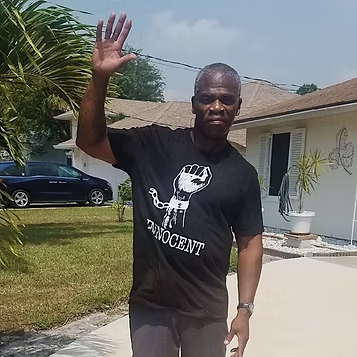
Leonard, right, with his nephew.
Although Detective Bell testified, she did not make any mentions of the guy she saw earlier that day by the school until days after the robbery. To identify a person from the vague description, she and her Lieutenant searched through a Track Repeat Arrestees Program (TRAP), a computer program containing information of people nearby who had been arrested or were on prisoner release.
On the basis of a claim made by the witness Venhuizen which described the robber’s physical appearance as “neat,” Lt. Stewart chose Leonard Cure’s file in the database because he seemed to be one picture in the database that suggested he maintained a well kept appearance. Detective Bell testified when the photograph chosen by Lieutenant Stewart was shown to her, she concluded Leonard was the man she saw walking by her patrol car in front of the elementary school. Although she didn’t connect Cure to the crime until she was shown the photo, she also testified another connection with Cure. A few months earlier when she was reviewing new criminal registrants and prison releases, she had been assigned to Cure and had met him previously at his residence.
As previously noted, Kathy Venhuizen indicated a missing tooth on the left side of the suspects face when describing him. Leonard Cure had both a missing side and front tooth; however, his girlfriend Enid Roman testified Cure wore a bridge and never left home without it. She never knew his teeth were missing until after they started dating.
Cure had an alibi for the time the crime occurred. Throughout investigation and trial he maintained that he left home the morning of the robbery around 6 a.m with Enid and her three children. After Enid dropped the children off at school and daycare, she then dropped Leonard off at a bus stop. After exiting the first bus and before catching the second bus on the route he took to work, Leonard stopped by an ATM. The ATM is three miles south of the Walgreens. Cure took out twenty dollars. The withdrawal was made at 6:52 a.m. This places him far from the crime at the same time it occurred. No video from the ATM was recovered by Cure’s first attorney and by the time the attorney was replaced with Cure’s trial attorney, over ninety days had passed which is the standard retention time for those types of video records.
Cure’s manager from his job testified that he had become a permanent worker with the company, because he was always on time and never gave any slack. Specifically, on the day in question Marty Weiss noted he entered the site at 8 a.m and Cure was already there. A co-worker at Presidential Towers where Cure worked additionally testified he always came to work around 7 a.m. each day. Additionally, Cure was paid in full for the entire day of the incident, however, the time-sheet was handwritten. Cure’s work attire was also described as construction boots and clothing suitable for construction work, not jean pants and a baseball cap.
For Cure to have visited the ATM, robbed the Walgreens, changed clothes, and made it to work on time, he would have had to drive his girlfriend’s car. This was the only considerable theory given by the prosecution, but an implausible one that contradicted both evidence and testimony. Despite the witnesses’ testimony the perpetrator was walking, the prosecution maintained this theory.
On August 17, 2004, the jury could not reach a unanimous decision, causing a mistrial. The prosecution proceeded to offer Leonard a plea agreement that in exchange for a guilty plea he would spend seven years in prison. Leonard refused on the basis of his innocence.
Trial 2:
The second trial began a few weeks later, only this time Rizk was a witness for the defense. Rizk testified he was not sure if Cure was the robber. Despite this, the jury reached a guilty verdict and Leonard Cure was sentenced to life in prison for armed robbery with a firearm and assault with a firearm.